Jim Crow laws were state and local laws that enforced racial segregation in the Southern United States. Enacted by white Democratic-dominated state legislatures in the late 19th century after the Reconstruction period, these laws continued to be enforced until 1965. They mandated de jure racial segregation in all public facilities in the states of the former Confederate States of America, starting in 1896 with a "separate but equal" status for African Americans in railroad cars. Public education had essentially been segregated since its establishment in most of the South after the Civil War. This principle was extended to public facilities and transportation, including segregated cars on interstate trains and, later, buses. Facilities for African Americans were consistently inferior and underfunded compared to those which were then available to European Americans; sometimes they did not exist at all. This body of law institutionalized a number of economic, educational, and social disadvantages. De jure segregation existed mainly in the Southern states, while Northern segregation was generally de facto—patterns of housing segregation enforced by private covenants, bank lending practices, and job discrimination, including discriminatory labor union practices. "Jim Crow" was a pejorative expression meaning "Negro".
Jim Crow laws—sometimes, as in Florida, part of state constitutions—mandated the segregation of public schools, public places, and public transportation, and the segregation of restrooms, restaurants, and drinking fountains for whites and blacks. The U.S. military was already segregated. President Woodrow Wilson, a Southerner, initiated segregation of federal workplaces at the request of southern Cabinet members in 1913.
These Jim Crow laws revived principles of the 1800–1866 Black Codes, which had previously restricted the civil rights and civil liberties of African Americans. Segregation of public (state-sponsored) schools was declared unconstitutional by the Supreme Court of the United States in 1954 in Brown v. Board of Education. In some states it took years to implement this decision. Generally, the remaining Jim Crow laws were overruled by the Civil Rights Act of 1964 and the Voting Rights Act of 1965, but years of action and court challenges have been needed to unravel the many means of institutional discrimination.
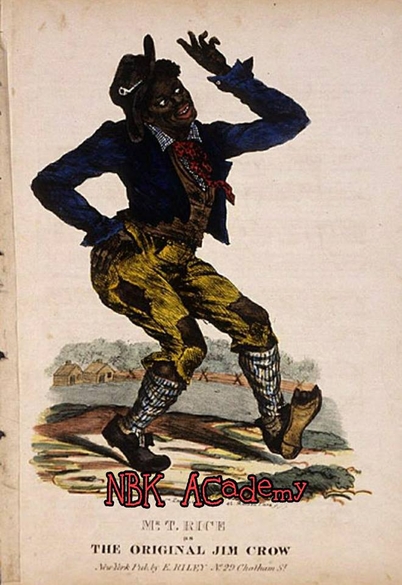
The phrase "Jim Crow Law" can be found as early as 1892 in the title of a New York Times article about Louisiana requiring segregated railroad cars.[1][2] The origin of the phrase "Jim Crow" has often been attributed to "Jump Jim Crow", a song-and-dance caricature of blacks performed by white actor Thomas D. Rice in blackface, which first surfaced in 1832 and was used to satirize Andrew Jackson's populist policies. As a result of Rice's fame, "Jim Crow" by 1838 had become a pejorative expression meaning "Negro". When southern legislatures passed laws of racial segregation directed against blacks at the end of the 19th century, these statutes became known as Jim Crow laws.
Sign Up: (FREE!)
NBK HISTORY BROTHERS Website
http://newblackknowledge1.connectplatform.... Subscribe:
NEW BLACK KNOWLEDGE YouTube
www.youtube.com/c/NewBlackKnowledge Instagram:
www.instagram.com/nbklyrad Twitter:
www.twitter.com/nbklyrad Facebook:
Join NBK SOCIAL GROUP
https://www.facebook.com/groups/NBKSocialG... NBK ACADEMY BLACK HISTORY PAGE
https://www.facebook.com/NBKAcademy1/
Posted By: NEW BLACK KNOWLEDGE
Tuesday, April 24th 2018 at 10:55AM
You can also
click
here to view all posts by this author...